JellyFil Official Website › Blog › Three Ingredients The Advertising Leaves Out
Three Ingredients JellyFil’s Advertising Leaves Out
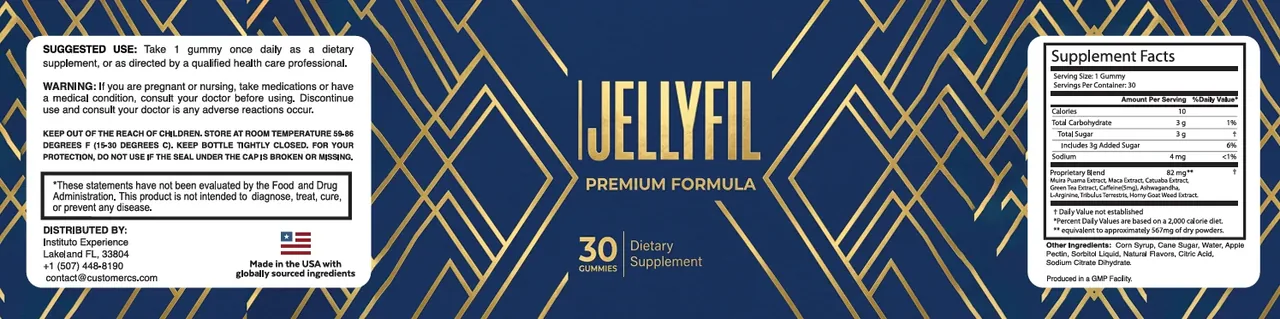
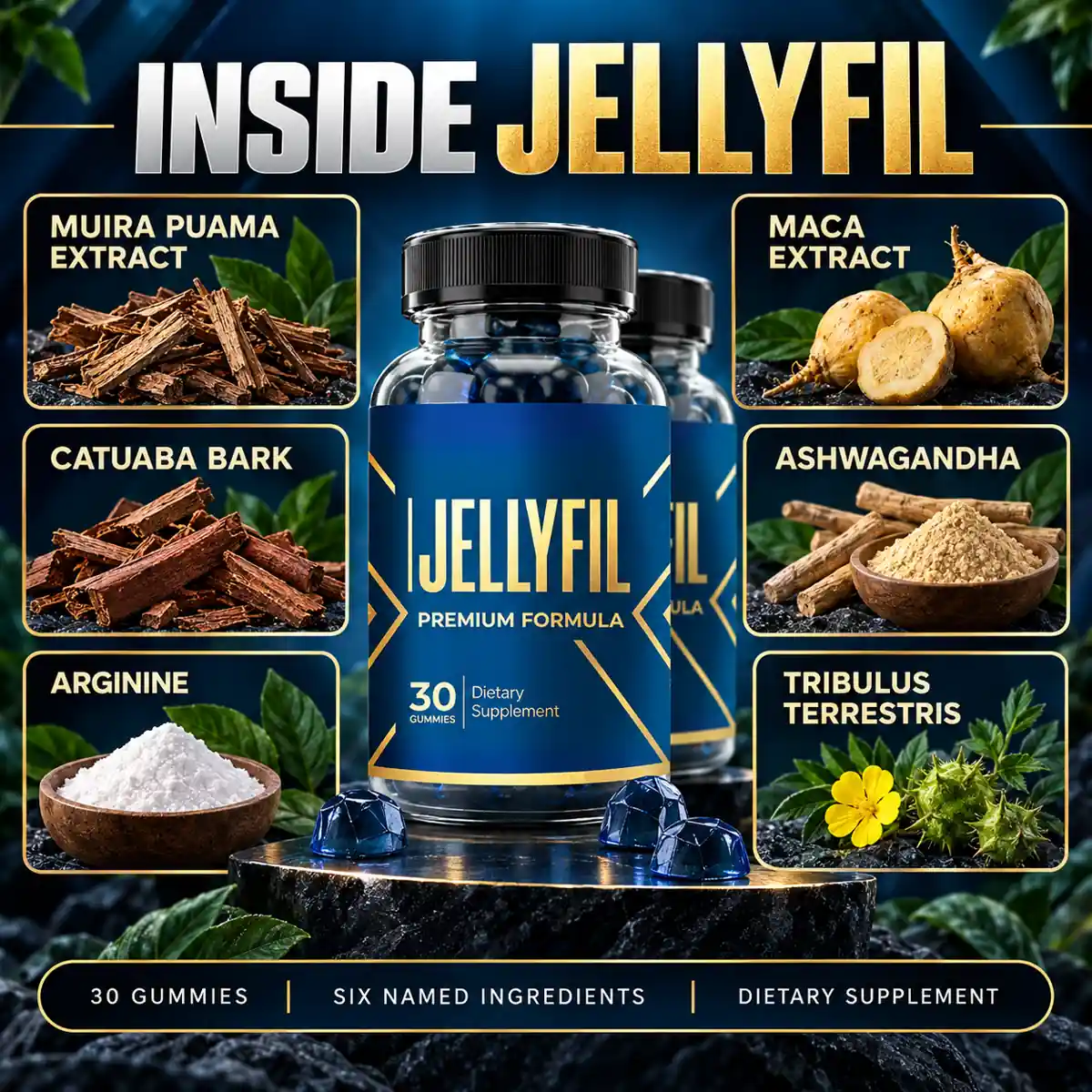
The sales copy for this gummy names six ingredients. The Supplement Facts panel printed on the bottle names nine. The three that appear only on the bottle are green tea extract, five milligrams of caffeine and horny goat weed extract — and two of those three are the ones a buyer with a prescription most needs to know about.
Two lists, one bottle
Almost every supplement in this category arrives with two accounts of what is in it. There is the list in the advertising, which is written to sell, and there is the Supplement Facts panel on the container, which is written to a regulation. Most of the time the two agree and nobody notices. When they disagree, the difference is usually the most informative thing about the product.
For JellyFil the difference is three names. Here are both lists side by side, in the order the panel prints them.
| Ingredient | In the sales copy | On the printed panel |
|---|---|---|
| Muira Puama Extract | Named | Named, first in the blend |
| Maca Extract | Named | Named |
| Catuaba | Named as Catuaba Bark | Named as Catuaba Extract |
| Green Tea Extract | Absent | Named, fourth |
| Caffeine | Absent | Named and quantified at 5 mg |
| Ashwagandha | Named | Named |
| Arginine | Named | Named as L-Arginine |
| Tribulus Terrestris | Named | Named |
| Horny Goat Weed Extract | Absent | Named, last |
Both columns were transcribed from the material supplied with this product: the sales copy on one side and the label artwork on the other.
Which list is the fact
The panel. Not because panels are sacred, but for three concrete reasons.
First, it is the statement on the container the buyer actually receives, and it is written to a labelling regulation rather than to a marketing brief. The FDA's own labelling guidance sets out what a Supplement Facts panel must contain and how a proprietary blend must be presented in it.
Second, it is the only one of the two lists that carries an amount. The advertising names six ingredients and quantifies none of them. The panel gives a blend total of 82 mg, a dry-powder equivalence of approximately 567 mg, and a separate figure of 5 mg for caffeine.
Third, it is longer. A shorter list on a container than in an advertisement would be a regulatory problem. A longer list on the container than in the advertisement is a marketing decision, and marketing decisions are the ones worth examining.
- Where the advertising and the printed panel disagree, the panel is printed.
- Where the panel publishes an amount, that amount is printed.
- Where it does not, nothing is estimated in its place.
The caffeine nobody mentions
Five milligrams. It is worth saying immediately that this is a small number: the FDA puts a brewed cup of coffee at roughly 80 to 100 mg, so one gummy carries about a twentieth of a cup, and a can of cola carries seven times more. Nobody is going to lie awake because of it.
That is not the point. The point is that somebody who avoids caffeine — because of an arrhythmia, because of anxiety, because a clinician asked them to — makes that decision by reading ingredient lists. A list that does not contain the word cannot serve them, however small the amount behind it would have been.
There is an irony here worth noting. Caffeine is the one ingredient on this panel that is declared with its own figure rather than hidden inside the blend, which is the single most transparent thing about the label. The advertising then leaves it out entirely.
Order JellyFil from the desk that prints the whole panel
One chewable gummy a day, 30 to a bottle, nine ingredients on the printed label and a 60-day money-back window counted from the day you pay.
Price shown at the seller’s checkout · 60-day window from purchase
Order JellyFil From This CounterLot JEL-26/JE-4012 · a month in every bottle · dispatched inside the United States
The one that meets prescriptions
Horny goat weed is the serious one, and it sits last on the panel, meaning it is present in the smallest amount of the nine.
Its active compound is icariin. Laboratory and animal work characterises it as a weak inhibitor of the PDE5 enzyme — which is the same enzyme family that prescription erectile drugs act on. That is not a scandal in itself; it is a real mechanism and a reasonable thing to include in a formula of this kind. It is a problem only because it is invisible in the advertising.
The MedlinePlus entry for epimedium lists the interactions that follow: nitrates, blood-pressure medicines, anticoagulants. Somebody taking any of those who read the six-name list and bought on it would have no reason to raise this gummy with their prescriber, because nothing in the list they read would prompt them to.
| The missing name | Who it matters to | Why |
|---|---|---|
| Caffeine, 5 mg | Anyone avoiding caffeine at all | Small, but a person avoiding it entirely cannot make that choice from a list it is not on. |
| Horny goat weed extract | Anyone on a nitrate, a blood-pressure medicine or a PDE5 inhibitor | Its active, icariin, is a weak PDE5 inhibitor: the same enzyme family a prescription erectile drug acts on. |
| Green tea extract | Anyone on an anticoagulant, and anyone reading for quality | It is one of the better-evidenced things in the bottle, which makes leaving it out a strange decision rather than a sinister one. |
Two of the three are safety-relevant. The third is simply good and unmentioned.
None of this means the gummy is dangerous. It means a specific buyer — the one with a nitrate or a blood-pressure tablet in the cupboard — needs a piece of information the advertising does not give them. That conversation with a prescriber takes about a minute and it is the whole reason this article exists.
The good one they left off
Green tea extract is the third missing name and it is the one that makes least sense commercially.
It is among the most studied plants in the supplement aisle. Its catechins have a described effect on vascular function, which is directly relevant to a product sold for circulation, and the NCCIH summary is a neutral account of both the benefits and the caveats, including the liver signal attached to concentrated extracts taken on an empty stomach.
A marketer with green tea in the formula would normally put it on the front of the bottle. Leaving it off suggests the sales copy and the label were written at different times by different people, working from different versions of the formula — which is much the most likely explanation for all three omissions, and considerably more boring than a conspiracy.
Why this happens at all
Formulas change. A sales page written for an earlier version does not automatically get rewritten when the manufacturer adds three ingredients, and in a category with contract manufacturers, private labels and several layers of reseller between the plant and the buyer, nobody owns the job of keeping the two in step.
That is the charitable reading and it is probably the correct one. It is also irrelevant to the buyer, because the effect is the same either way: a person can read the advertising carefully, buy in good faith, and take three things they did not know about.
- A sales page is written to persuade and is not a regulated document.
- A Supplement Facts panel is a regulated statement about the container it is printed on.
- When they disagree, only one of them travels with the bottle to your kitchen.
- A retail desk that prints only the flattering list is not being careful with you.
What a buyer should actually do
Nothing complicated, and it takes about two minutes on any product in this aisle.
- Find the Supplement Facts panel — on the bottle, or in the label artwork a decent retail page reproduces.
- Count the ingredients on it and count the ones in the advertising. If the numbers differ, work out which names are missing.
- Check whether any of the missing names is a stimulant or has a known interaction. Those are the two categories that matter.
- If one does, and you take a prescription, ask your prescriber before the first dose rather than after the first bottle.
- Buy through a channel with a lot number and a telephone number, so that a question later has somewhere to go. On this desk that is +1 (507) 448-8190.
The whole nine-name list, each with the amount its own research used, is on the JellyFil ingredients page, and the panel is transcribed row by row on the Supplement Facts page. The interactions are set out practically on the side effects page.
JellyFil is a dietary supplement, not a medicine, and nothing on this page treats or prevents any condition. Two of the nine ingredients on its panel act on the same pathway as nitrates, blood-pressure medicines and prescription PDE5 inhibitors, so anyone taking one of those should raise this gummy with whoever prescribes it before the first one. MedlinePlus carries the entry for the ingredient that matters most.
References
- Shindel AW, Xin ZC, Lin G, et al. Erectogenic and neurotrophic effects of icariin, a purified extract of horny goat weed (Epimedium spp.) in vitro and in vivo. Journal of Sexual Medicine. 2010. https://onlinelibrary.wiley.com/doi/abs/10.1111/j.1743-6109.2009.01699.x
- MedlinePlus, U.S. National Library of Medicine. Epimedium (horny goat weed). https://medlineplus.gov/druginfo/natural/699.html
- National Center for Complementary and Integrative Health. Green tea. https://www.nccih.nih.gov/health/green-tea
- U.S. Food and Drug Administration. Spilling the beans: how much caffeine is too much? https://www.fda.gov/consumers/consumer-updates/spilling-beans-how-much-caffeine-too-much
- U.S. Food and Drug Administration. Dietary supplement labeling guide: chapter IV, nutrition labeling, including proprietary blends. https://www.fda.gov/food/dietary-supplements-guidance-documents-regulatory-information/dietary-supplement-labeling-guide-chapter-iv-nutrition-labeling