JellyFil Official Website › Blog › What An 82 mg Blend Can Hold
Nine Ingredients, 82 Milligrams: What A Blend That Size Can Hold
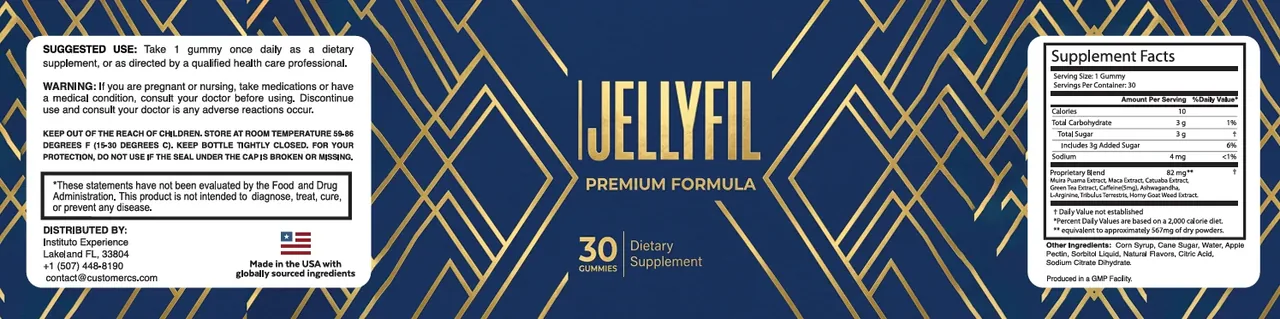
The JellyFil panel prints one Proprietary Blend of 82 mg covering nine ingredients, annotated as equivalent to approximately 567 mg of dry powders. This is what those two numbers mean, what they cannot tell you, and how they compare with the doses the published research on those same ingredients actually used.
What a proprietary blend is
A proprietary blend is a group of ingredients given one combined weight instead of individual weights. It is legal, it is extremely common, and the FDA's labelling guidance sets out exactly how one must be presented: the ingredients listed in descending order of weight, with a single total for the group.
The stated commercial reason is protecting a formula from being copied. The practical consequence for a buyer is that a single number replaces nine, and nine ingredients become impossible to evaluate individually.
There is one piece of real information inside the rule, and it is worth using. Descending order of weight means the first name on the list is present in the largest amount and the last in the smallest. On this panel that means muira puama is the largest component and horny goat weed the smallest.
- It tells you the rank: muira puama first, horny goat weed ninth.
- It does not tell you the gaps. The first could be 40 mg or 12 mg.
- It does tell you that an even split is false, which rules out the friendliest arithmetic.
The two numbers on this panel
This label publishes exactly two per-serving amounts that relate to the actives, and it is worth being precise about them because most of the confusion in this category lives here.
82 mg is the Proprietary Blend total: everything in the blend, added together, per gummy. 5 mg is caffeine, named inside the blend line with its own figure, which is the one genuinely transparent gesture on the label. There is also a footnote reading approximately 567 mg of dry powders, which is not a third amount but a restatement of the first.
Everything else — how much maca, how much ashwagandha, how much arginine — is undisclosed, and no page on this website estimates it.
Extract or powder: what 567 mg means
This footnote does real work and it is the most misread line on the label, so it is worth slowing down for.
A botanical extract is made by taking raw plant material and concentrating the fraction somebody wants. A 10:1 extract means ten kilograms of raw material produced one kilogram of extract. So 82 mg of extract can legitimately be described as equivalent to several hundred milligrams of the powder it came from — here, approximately 567 mg, which works out at roughly a 7:1 average concentration across the blend.
That is a genuine improvement over 82 mg of raw powder and it narrows the gap against the trial doses. It does not close it, for two reasons. Extraction concentrates some compounds and not others, so equivalence by weight is not equivalence by activity. And the trials in the next section mostly used a single ingredient, not a ninth of a blend.
- 82 mg is the real weight in the gummy.
- 567 mg is what that weight is said to correspond to in raw material.
- Neither figure is split between the nine ingredients.
- An equivalence by weight is not an equivalence by effect.
Order JellyFil from the desk that prints the whole panel
One chewable gummy a day, 30 to a bottle, nine ingredients on the printed label and a 60-day money-back window counted from the day you pay.
Price shown at the seller’s checkout · 60-day window from purchase
Order JellyFil From This CounterLot JEL-26/JE-4012 · a month in every bottle · dispatched inside the United States
The gap against the trial doses
Here is the comparison the whole category is built on avoiding. The left column is what each ingredient’s own published research used, per day, usually of that ingredient alone.
| Ingredient | Dose its published trials used, per day | What the blend can offer |
|---|---|---|
| Maca | 1,500–3,000 mg of maca alone | A share of 82 mg |
| Ashwagandha | 240 mg and up, standardised extract | A share of 82 mg |
| L-Arginine | Gram-scale intakes | A share of 82 mg |
| Green tea catechins | Catechin intakes far above a gummy | A share of 82 mg |
| Caffeine | 80–100 mg is a cup of coffee | 5 mg, declared |
The left column is what each ingredient’s own research used. It is context for judging an ingredient, not a description of what is in this gummy.
The maca trial that reported improved sexual desire in healthy men ran twelve weeks at gram-scale doses of maca on its own. The ashwagandha trial that reported falls in morning cortisol used 240 mg of a standardised extract. Reviews of oral arginine find blood-pressure effects at gram-scale intakes, and the green tea blood-pressure meta-analysis pooled studies of tea consumption rather than of a few milligrams of extract.
Against any of those, a share of 82 mg is small. Applying the dry-powder equivalence generously still leaves the figures an order of magnitude apart for maca and arginine.
Four ways to read 82 mg, and the honest one
Because the split is undisclosed, several readings are arithmetically possible. Setting them beside each other is more useful than picking one.
| Reading | What it assumes | Per-ingredient result |
|---|---|---|
| Even split | All nine equal — which a panel ordered by weight tells us is false | About 9 mg each |
| Front-loaded | The first three carry most of the weight | Perhaps 15–20 mg each at the top, 2–4 mg at the bottom |
| Dry-powder equivalent | The 567 mg annotation applied evenly | About 63 mg each of equivalent raw material |
| The honest answer | Nothing, because the split is not disclosed | Unknown |
Only the last row is a fact. The first three are arithmetic on an assumption, printed so a reader can see how wide the range of possible readings is.
The last row is the only one that is true. Everything above it is a model, and a model of an undisclosed quantity is a guess with a table around it. This site prints the range so a reader can see how much the answer moves, not so they can pick a comfortable number out of it.
What a better label would look like
Worth sketching, because it is easy to criticise a proprietary blend and harder to say what the alternative actually is.
A fully open label would print a milligram figure beside each of the nine names, and the figures would add to 82 mg. Nothing else would change: the same ingredients, the same gummy, the same price. A buyer could then look at the ashwagandha row, compare it with the 240 mg the trial used, and decide. That decision is the thing a blend removes, and it is removed from the buyer rather than from the competitor.
A partially open label is the commoner middle ground and it is better than nothing: figures for the two or three ingredients doing the work, and a blend for the rest. This label does a version of that already with its caffeine line, which is why the caffeine line is the most honest thing on it.
There is a further step almost nobody takes. An extract is only meaningful with its ratio and its standardisation attached — a 10:1 extract standardised to a named marker compound is a different material from an unspecified extract at the same weight. None of that appears here, and it appears on very few labels in this category.
- Best: a milligram figure for every named ingredient.
- Good: figures for the actives that matter, a blend for the flavour and filler.
- Common: one blend total, as here, plus one declared stimulant.
- Worst: a list of names with no panel at all, which does happen in this aisle.
So is it worth anything?
A fair question, and the answer is neither of the two convenient ones.
The dishonest positive answer would be that nine botanicals work together, so small amounts add up. There is no evidence for that with this combination; nobody has trialled it.
The dishonest negative answer would be that 82 mg is nothing, so the product does nothing. That is not established either. Most of these ingredients have never been tested at small daily amounts over months, because there is no commercial reason to run that trial. Absence of evidence at a dose is not evidence of absence at that dose.
What can honestly be said is narrower and more useful. The amounts are well below what the published research used. Nobody can tell you the split. A person who wants a known quantity of one ingredient should buy that ingredient on its own, and a person who wants a daily habit with several botanicals in it is buying something different and should know that is what they are buying.
A 60-day money-back window, counted from the date of purchase. It does not tell you what is in the blend, but it does mean the question can be answered on your own body at a bounded cost. The guarantee page sets out how it is counted.
JellyFil is a dietary supplement, not a medicine, and nothing on this page treats or prevents any condition. Two of the nine ingredients on its panel act on the same pathway as nitrates, blood-pressure medicines and prescription PDE5 inhibitors, so anyone taking one of those should raise this gummy with whoever prescribes it before the first one. MedlinePlus carries the entry for the ingredient that matters most.
References
- U.S. Food and Drug Administration. Dietary supplement labeling guide: chapter IV, nutrition labeling, including proprietary blends. https://www.fda.gov/food/dietary-supplements-guidance-documents-regulatory-information/dietary-supplement-labeling-guide-chapter-iv-nutrition-labeling
- Gonzales GF, Cordova A, Vega K, et al. Effect of Lepidium meyenii (MACA) on sexual desire and its absent relationship with serum testosterone levels in adult healthy men. Andrologia. 2002 Dec. Randomized controlled trial. https://pubmed.ncbi.nlm.nih.gov/12472620/
- Lopresti AL, Smith SJ, Malvi H, Kodgule R. An investigation into the stress-relieving and pharmacological actions of an ashwagandha (Withania somnifera) extract: a randomized, double-blind, placebo-controlled study. Medicine (Baltimore). 2019 Sep. https://pubmed.ncbi.nlm.nih.gov/31517876/
- Khalaf D, Kruger M, Wehland M, Infanger M, Grimm D. The effects of oral l-arginine and l-citrulline supplementation on blood pressure. Nutrients. 2019. https://www.ncbi.nlm.nih.gov/pmc/articles/PMC6683098/
- Peng X, Zhou R, Wang B, Yu X, Yang X, Liu K, Mi M. Effect of green tea consumption on blood pressure: a meta-analysis of 13 randomized controlled trials. Scientific Reports. 2014. https://www.nature.com/articles/srep06251